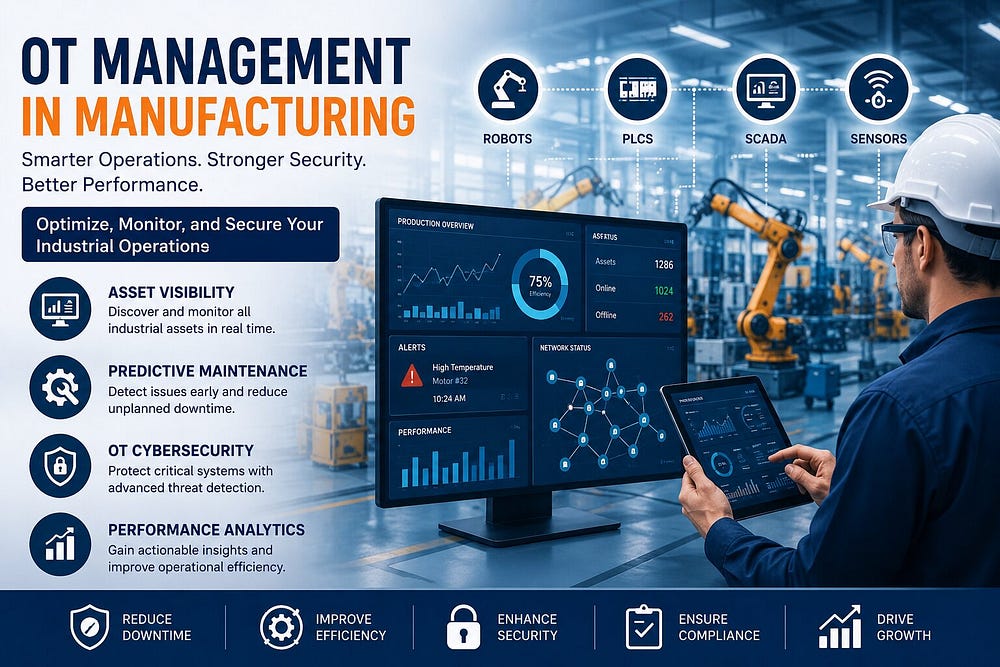
Manufacturers today operate in an environment where downtime is costly, cyber threats are increasing, and production efficiency directly impacts profitability. As factories become more connected through Industrial IoT, automation, and smart technologies, Operational Technology (OT) Management has emerged as a critical business function.
OT Management refers to the governance, monitoring, maintenance, and security of industrial systems that control physical operations, including PLCs, SCADA systems, sensors, robotics, and production equipment. Unlike traditional IT systems that manage data, OT systems control real-world industrial processes and machinery.
Why OT Management Matters in Manufacturing
Modern manufacturing facilities rely on hundreds or even thousands of interconnected assets. Without proper OT management, organizations face challenges such as:
- Unplanned production downtime
- Limited visibility into industrial assets
- Increased cybersecurity risks
- Compliance and safety concerns
- Higher maintenance and operational costs
Effective OT management creates a centralized approach to monitoring assets, managing risks, and optimizing plant performance. It enables manufacturers to maintain operational continuity while supporting digital transformation initiatives.
Key Components of Effective OT Management
1. Asset Visibility and Inventory Management
You cannot manage what you cannot see. A comprehensive inventory of OT assets helps organizations understand their industrial environment, identify vulnerabilities, and improve maintenance planning. Asset visibility serves as the foundation for operational resilience and cybersecurity.
2. Predictive Maintenance
By collecting real-time data from machines and sensors, manufacturers can detect performance issues before failures occur. Predictive maintenance reduces downtime, extends equipment lifespan, and lowers maintenance expenses.
3. OT Cybersecurity
As IT and OT environments continue to converge, industrial systems are increasingly exposed to cyber threats. Modern OT management strategies include network segmentation, continuous monitoring, access controls, and threat detection to protect critical production systems.
4. Performance Monitoring and Analytics
Real-time dashboards and analytics help operations teams track machine utilization, production efficiency, and operational bottlenecks. These insights support faster decision-making and continuous improvement initiatives.
Benefits of OT Management for Manufacturers
Organizations that invest in OT management can achieve:
- Improved operational efficiency
- Reduced production downtime
- Enhanced cybersecurity posture
- Better regulatory compliance
- Increased asset reliability
- Greater visibility across plant operations
- Stronger support for Industry 4.0 initiatives
Industry experts increasingly emphasize that asset management and visibility are foundational requirements for building secure and resilient OT environments.
The Future of OT Management
As manufacturing continues its digital transformation journey, OT management will evolve beyond monitoring and maintenance. AI-driven analytics, autonomous operations, digital twins, and advanced cybersecurity capabilities will help manufacturers create smarter and more resilient factories. Organizations that establish strong OT management practices today will be better positioned to improve productivity, reduce risk, and maintain a competitive advantage in the years ahead.
Conclusion
OT Management is no longer optional for modern manufacturers. It is a strategic capability that connects operational efficiency, cybersecurity, asset performance, and business resilience. By implementing a structured OT management framework, manufacturers can unlock greater visibility, reduce operational risks, and accelerate their journey toward smart manufacturing excellence.