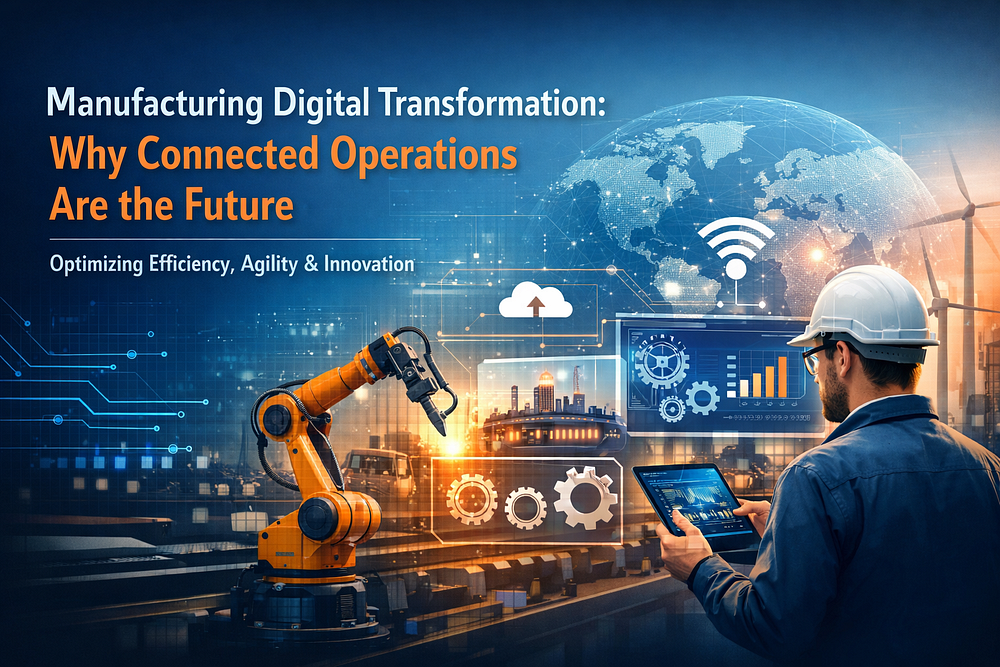
The manufacturing industry is no longer competing on production capacity alone. Today, the real competitive edge belongs to companies that can connect their machines, systems, and people- and turn real-time data into faster, smarter decisions.
From shop floor inefficiencies to unpredictable supply chains, manufacturers face pressures coming from every direction at once. Labor shortages, rising energy costs, cyberattacks on operational technology systems, and increasing customer expectations have made it clear: operating on legacy infrastructure and manual workflows is no longer sustainable.
The Real Cost of Staying Traditional
Unplanned downtime alone can cost manufacturers up to $1 million per hour in large production environments. Yet many facilities still depend on reactive maintenance -fixing equipment only after it breaks. Add siloed data, disconnected ERP and MES systems, and paper-based reporting, and the result is a business that reacts slowly and loses competitive ground daily.
The skills gap makes it worse. Experienced workers who built and maintained legacy systems are retiring, while newer talent often lacks hands-on operational technology experience. This creates a dangerous readiness gap between where manufacturers are today and where they need to be.
Technology Is Not the Bottleneck Anymore
IoT sensors monitor equipment health continuously. AI predicts failures before they happen. Digital twins simulate process changes without halting production. Cloud platforms standardize data across multiple plant locations. Augmented reality guides technicians through complex maintenance in real time.
The challenge is not access to these technologies - it is making them work together. Most digital transformation efforts fail not because of bad technology choices, but because of poor orchestration. A sensor can detect a problem. But if that alert does not automatically create a work order, check parts availability, assign the right technician, and notify the supervisor- the value stops at the alert.
Platforms Are the Missing Link
This is why unified platforms like ServiceNow are becoming central to manufacturing transformation strategies. Rather than managing disconnected tools, manufacturers are building a connected digital backbone where production, IT, supply chain, field service, and workforce management all operate from shared data and automated workflows. The results are measurable: improved Overall Equipment Effectiveness (OEE), reduced downtime, faster service resolution, and stronger supply chain resilience.
For a deep dive into how manufacturers across automotive, pharma, electronics, and heavy industries are executing this transformation - including specific use cases, technology frameworks, and platform strategies - this comprehensive guide is worth reading: Digital Transformation in Manufacturing by Aelum Consulting.
The Bottom Line
Digital transformation in manufacturing is not a future initiative - it is an ongoing operational necessity. Companies that build connected, data-driven enterprises today will outperform those still running on disconnected systems tomorrow. The factory is changing. The playbook has to change with it.
No comments:
Post a Comment