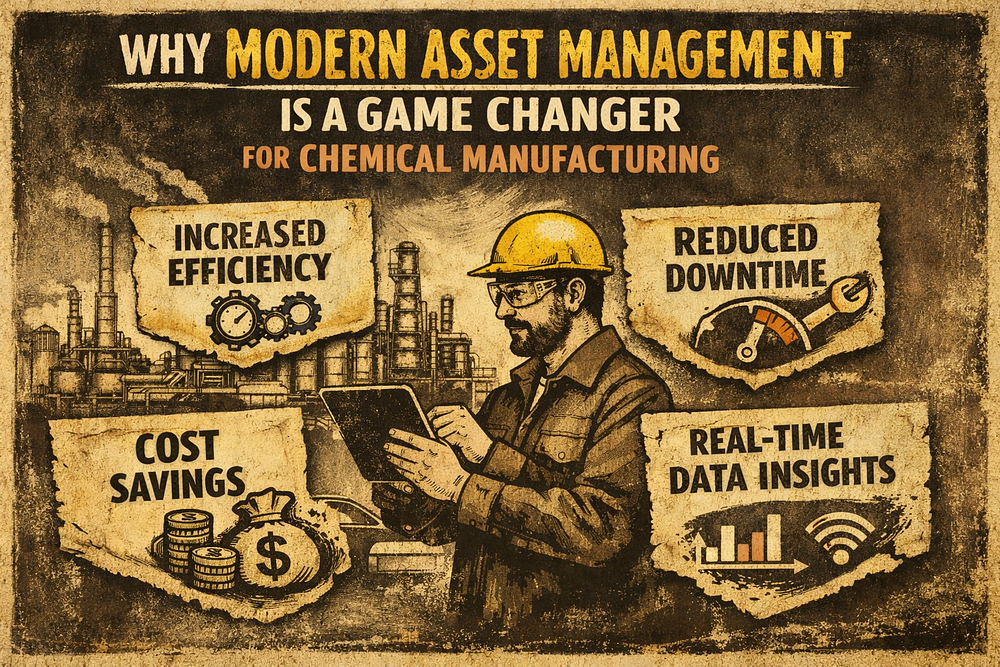
In chemical manufacturing, assets are the backbone of operations. Equipment such as reactors, pumps, compressors, heat exchangers, pipelines, storage tanks, and control systems directly impact safety, compliance, productivity, and profitability.
A single asset failure can result in unplanned downtime, safety incidents, environmental damage, regulatory penalties, and major financial losses.
This is why Modern Asset Management has become a true game changer for chemical manufacturers worldwide.
1. Why Traditional Asset Management No Longer Works
Many chemical plants still rely on:
- Reactive maintenance
- Time-based preventive maintenance
- Manual inspections
- Disconnected systems and spreadsheets
Limitations of traditional approaches:
- Unexpected equipment failures
- High maintenance and repair costs
- Limited visibility into asset health
- Increased safety and compliance risks
- Poor long-term asset planning
In today’s complex, highly regulated chemical plants, this approach is no longer sustainable.
2. What Is Modern Asset Management?
Modern Asset Management is a data-driven, predictive, and integrated approach that manages assets across their entire lifecycle.
Key lifecycle stages include:
- Asset design and procurement
- Installation and commissioning
- Real-time monitoring and operation
- Predictive and condition-based maintenance
- Asset optimization and retirement planning
The objective is simple:
- Maximize asset uptime
- Minimize operational risk
- Optimize maintenance costs
- Ensure regulatory compliance
3. Predictive Maintenance: The Biggest Advantage
At the core of modern asset management is Predictive Maintenance.
How it works:
- IoT sensors capture real-time data such as vibration, temperature, pressure, and flow
- Advanced analytics and AI detect patterns and early warning signals
- Potential failures are identified before they occur
Business impact:
- Reduced unplanned downtime
- Lower emergency repair costs
- Extended asset life
- Improved plant reliability
- Enhanced operational safety
For chemical manufacturers, predictive maintenance delivers higher reliability with lower risk.
4. Strengthening Safety and Regulatory Compliance
Safety and compliance are non-negotiable in chemical manufacturing.
Modern asset management enables:
- Digital inspection and maintenance records
- Automated compliance tracking
- Audit-ready documentation
- Real-time alerts for critical asset conditions
- Enforcement of standard operating procedures
This results in:
- Fewer safety incidents
- Faster and smoother regulatory audits
- Reduced environmental and compliance risks
5. Integrated Systems for Better Decision-Making
Modern asset management platforms integrate:
- EAM / CMMS
- ERP
- MES
- Supply Chain and Inventory systems
Benefits of integration:
- A single source of truth for asset data
- Accurate maintenance and spare parts planning
- Real-time performance dashboards
- Faster and more informed decision-making
Management gains complete visibility into asset health, costs, risks, and performance.
6. Cost Optimization and Asset Life Extension
Modern asset management directly improves financial performance.
Key advantages include:
- Reduced unplanned maintenance expenses
- Optimized spare parts inventory
- Improved capital investment planning
- Extended equipment lifecycle
- Higher Return on Assets (ROA)
Chemical manufacturers can operate more efficiently and competitively while controlling costs.
7. Enabling Sustainability and Industry 5.0
Sustainability is now a strategic priority in chemical manufacturing.
Modern asset management supports:
- Energy efficiency monitoring
- Leak detection and loss reduction
- Lower emissions
- Environmentally responsible operations
By combining automation, analytics, and human-centric decision-making, modern asset management aligns perfectly with the vision of Industry 5.0.
Conclusion
Modern Asset Management is not just a technology upgrade - it is a strategic transformation for chemical manufacturers.
Organizations that adopt it achieve:
- Safer plant operations
- Higher equipment uptime
- Lower operational and compliance risks
- Improved sustainability and profitability
